|
"I count a lot of things that there's no need to count," Cameron said. "Just because that's the way I am. But I count all the things that need to be counted." Richard Brautigan, The Hawkline Monster: A Gothic Western, Picador, 1976. |
|
Them as counts counts moren them as dont count Russell Hoban, Riddley Walker, Jonathan Cape, 1980. |
I am Emeritus Professor of Mathematics in the School of Mathematical Sciences at Queen Mary, University of London. The street address, phone and fax numbers, and directions, are given below. A picture of the College is here (taken by John Winfield, licensed under Creative Commons licence).
I am currently a half-time Professor of Mathematics and Statistics at the University of St Andrews. My St Andrews homepage is here.
For information about research in mathematics, see the School's research page; for details of postgraduate study see the postgraduate page. Please note that, while I am happy to give advice about postgraduate study, management no longer permit me to supervise PhD students.
I am interested in permutation groups, and the (finite or infinite) structures on which they can act (which may be designs, graphs, codes, geometries, etc.). Those countably infinite structures with the most symmetry are the ones which can be specified by first-order logical axioms; this is a general framework which includes many counting problems for types of finite structures. More recently my interests have extended to transformation semigroups. To get more detailed information, take a look at the abstracts of my recent and forthcoming papers, the problems which have appeared on this page, or my conjectures. Like the hero of Richard Brautigan's novel, I like to count things!
Some of my current interests are the connections between optimal designs and Laplace eigenvalues of multigraphs; homomorphisms and cores of symmetric graphs, which connect with automata theory and permutation groups; algebraic number theory properties of chromatic roots; orbit-counting versions of the Tutte and related polynomials; isometry groups of the Urysohn metric space; products of permutation groups; a 2-(14080,1444,148) design (constructed by Hunt and Rudvalis) admitting the Fischer group Fi22, and a 2-(1408,336,80) design (constructed by Praeger and me) admitting 212:(3M22.2); equivalence and typical properties of Latin squares; asymptotics of various counting problems (incidence matrices, 2-covers, etc.); further properties of the random graph and related groups; and transformation semigroups generated by a permutation group and one more element.
| Undergraduate | Postgraduate |
|---|---|
We run a Combinatorics Study Group during term-time. Please join us if you are visiting London: we meet at 4:30pm on Fridays in room M103 in the Mathematical Sciences building, Queen Mary, University of London (nearest tube Stepney Green, see map). See the Study Group Homepage for further details including this week's speaker.
I kept the records of the London Algebra Colloquium for some time, but these have now been passed on. You can find them here.
I also kept records for the Queen Mary Pure Mathematics seminar, from 2002 to 2010. The current list is on the seminar webpage.
The Design Research Group page provides information about research here in design theory and related topics. It includes a page devoted to design resources on the Web. It also contains details of our EPSRC-funded project "A Web-based resource for design theory", whose official website is at DesignTheory.org.
I am currently the chairman of the British Combinatorial Committee.
BCC information is being transferred to a new home, https://britishcombinatorial.wordpress.com/. The conference list is at https://britishcombinatorial.wordpress.com/conferences/. At some point, the pages on my site at QM will no longer be maintained. Please update your bookmarks!
The 25th British Combinatorial Conference will be held at the University of Warwick, from 6 to 10 July 2013.
See also the on-line British Combinatorial Bulletin.
One of the best things about being a mathematician is the opportunity to travel. I have kept various travel diaries. There are some other diaries here too, including Chapter 1 of my autobiography and a readable version of my 2008 G. C. Steward Lectures at Cambridge.
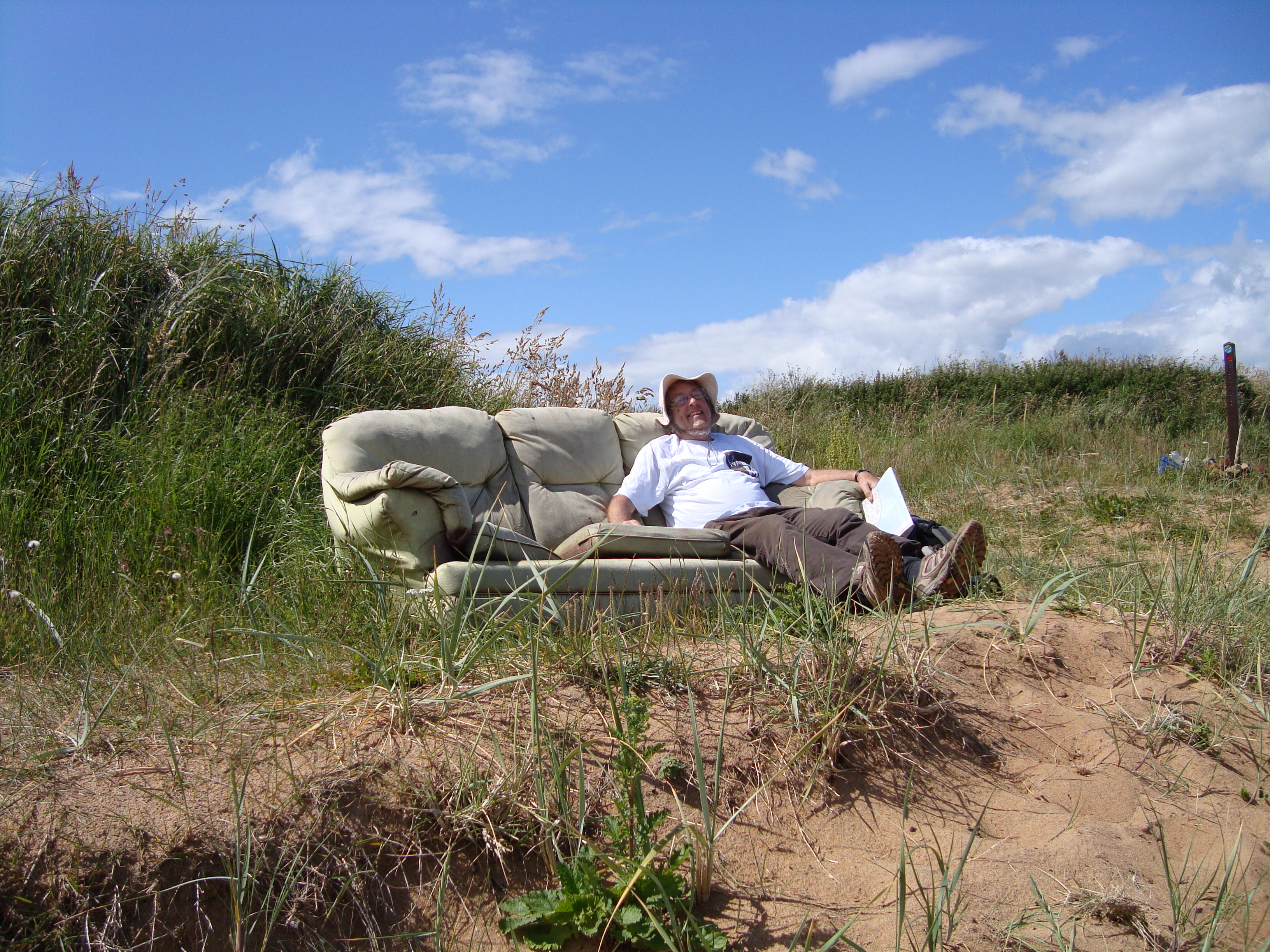
Apart from this now stressful profession, I used to run (I ran the London Marathon twice in the late 80s, best time 2:46:59), but now I spend time walking along the footpaths and bridleways of Britain. A list of "named" walks I have completed is available here (including a picture, which will be changed from time to time). This picture shows me on a particularly arduous stretch of the Fife Coastal Path in June 2009.
Miscellanea:
Let X be a graph on the vertex set V. The operation of switching X with respect to a subset A of V involves changing all edges between A and its complement into non-edges, and all non-edges into edges, while leaving adjacency within A or its complement unaltered. Switching is an equivalence relation on the set of graphs on V, whose equivalence classes are called switching classes.
We can define the automorphism group of a switching class in the obvious way; it contains the automorphism groups of the graphs in the class as subgroups.
Problem: Show that, with the exception of the switching classes of the complete and null graphs and finitely many others, a switching class whose automorphism group is primitive contains a graph whose automorphism group is trivial. Find all the finitely many exceptions.
The first part has been solved, and the only exceptions of odd degree are the switching classes of the 5-cycle and the line graph of K3,3.
Telephone:
Directions: Go to Stepney Green station. (Interactive Tube map here; zoom in to East sector.) On leaving the station, turn left, continue for 400 metres along Mile End Road to the Mathematical Sciences building. The building is recognizable by the Penrose tiling on the outside.
If coming by bus, take the number 25 or 205: the nearest stop is Ocean Estate, a request stop between Stepney Green Station and Queen Mary College.
The views and opinions expressed in this page are mine. The College does not have editorial control over this page and does not endorse, warrant or take responsibility for its content, including the second quote below.
The contents may change at any time!
|
Doubtless, good works are better than great knowledge, but without knowledge it is impossible to do good. Charles the Great, Capitularia regum francorum. |
|
Clearly we must explain more forcibly, especially at the highest levels of government, that the primary goal of universities is teaching and research, and that income is a constraint, and not the value to be maximised. Andrew Graham, Balliol College Register, 2005. |
|
We who often glorify our tendency to ignore reason, installing in its place blind faith, valuing it as spiritual, are forever paying for its cost with the obscuration of our mind and destiny.
Rabindranath Tagore |
|
Many teachers will say that 'you cannot express the inexpressible', and they do not try. But teachers like Yasutani and Maezumi don't agree, and I feel as they do: if you perceive deeply enough, a clear and simple way to express it can be found. Tetsugen (Bernard Glassman), quoted in Peter Matthiessen, Nine-headed Dragon River, Shambhala 1998. |
|
As Don Braben so aptly put it, funding the technology but not the basic research on which it depends is "living off the seedcorn". Leslie Ann Goldberg |
If I give the answer, you immediately forget about the question. If I don't give you the answer, you will still have questions and you will be thinking about the problem long after.
Eugene A. Geist |
… the university's purpose … is not to maximize revenue but to
serve the common good through teaching and research. It is true that teaching
and research are expensive, and universities devote much effort to fund-raising.
But when the goal of money making predominates … the university has
strayed far from the scholarly and civic goods that are its primary reason
for being.
Michael J. Sandel, Justice |
This page maintained by Peter J. Cameron
P.J.Cameron(AT)qmul.ac.uk
Revised 19 September 2015